A for Adventure: why everyday adventure matters in the early years

What does adventure mean in the early years?
In the early years, adventure means giving children chances to explore, discover and imagine beyond the familiar. It is less about big trips and more about small moments of excitement: a new path, an unexpected find, a den in the corner of the garden or an imaginary world built from boxes.
Young children are natural explorers. When adults protect time and space for that exploring, ordinary days start to feel full of possibility.
Why does adventure matter for young children's learning?
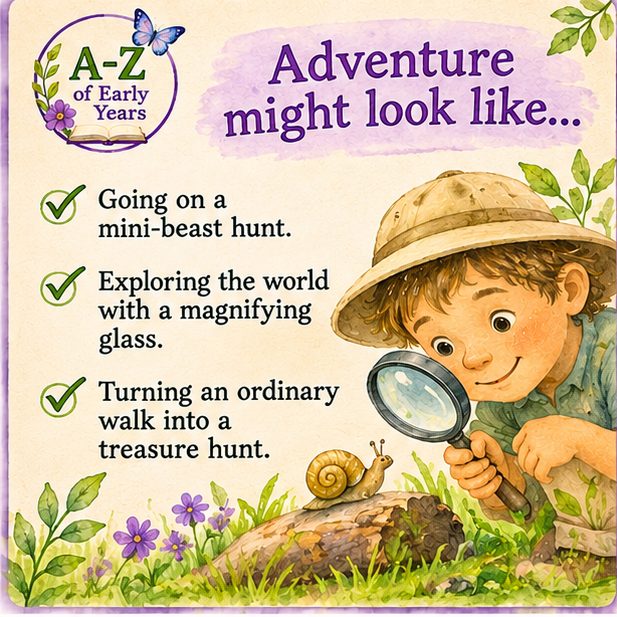
Adventure gives children a real reason to use their skills. On a minibeast hunt they are counting legs, describing colours, asking questions and taking turns with the magnifying glass. The excitement is what keeps them engaged long enough to learn.
- Curiosity and inquiry: children ask questions and test their own ideas.
- Communication and language: new experiences bring new words and lots to talk about.
- Physical development: climbing, balancing, crouching and carrying build gross and fine motor skills.
- Confidence and resilience: managing small, healthy challenges helps children trust themselves.
- Imagination: a stick becomes a wand, a log becomes a pirate ship, a garden becomes a jungle.
Do children need worksheets to learn?
Structured activities have their place, but young children learn best through hands-on, meaningful experiences. Very few people look back on their early years and remember a particularly lovely worksheet. What tends to stay with us are the moments that felt exciting, imaginative and our own.
What can adventure look like in a nursery or Reception class?
Adventure does not need expensive resources. Try these simple ideas:
- Go on a minibeast hunt with magnifying glasses and clipboards.
- Turn an ordinary walk into a treasure hunt with picture clues.
- Build a den or a reading tent with sheets, pegs and cushions.
- Leave a mysterious footprint trail for children to find.
- Explore the outdoors in every weather: puddles, wind, frost and shadows.
- Pack an explorer's bag with binoculars, a map and a notebook for mark making.
Bring A for Adventure into your setting
Start with the free Explorer Bag Checklist, or get the Outdoor Adventure Bundle with minibeast, den building, weather and treasure hunt resources.
How can families bring adventure into everyday life at home?
At home, adventure can be as simple as a walk to the shop with a “spot five red things” challenge, a picnic on the living room floor or a torch-lit hunt for teddy at bedtime. Follow your child's lead, slow down and say yes to the small detours.
How do you keep adventure safe?
Good adventure is about well-managed, age-appropriate challenge. Check spaces beforehand, talk with children about how to stay safe and stay close enough to support without taking over.
“It's those adventurous, imaginative moments that children remember.”